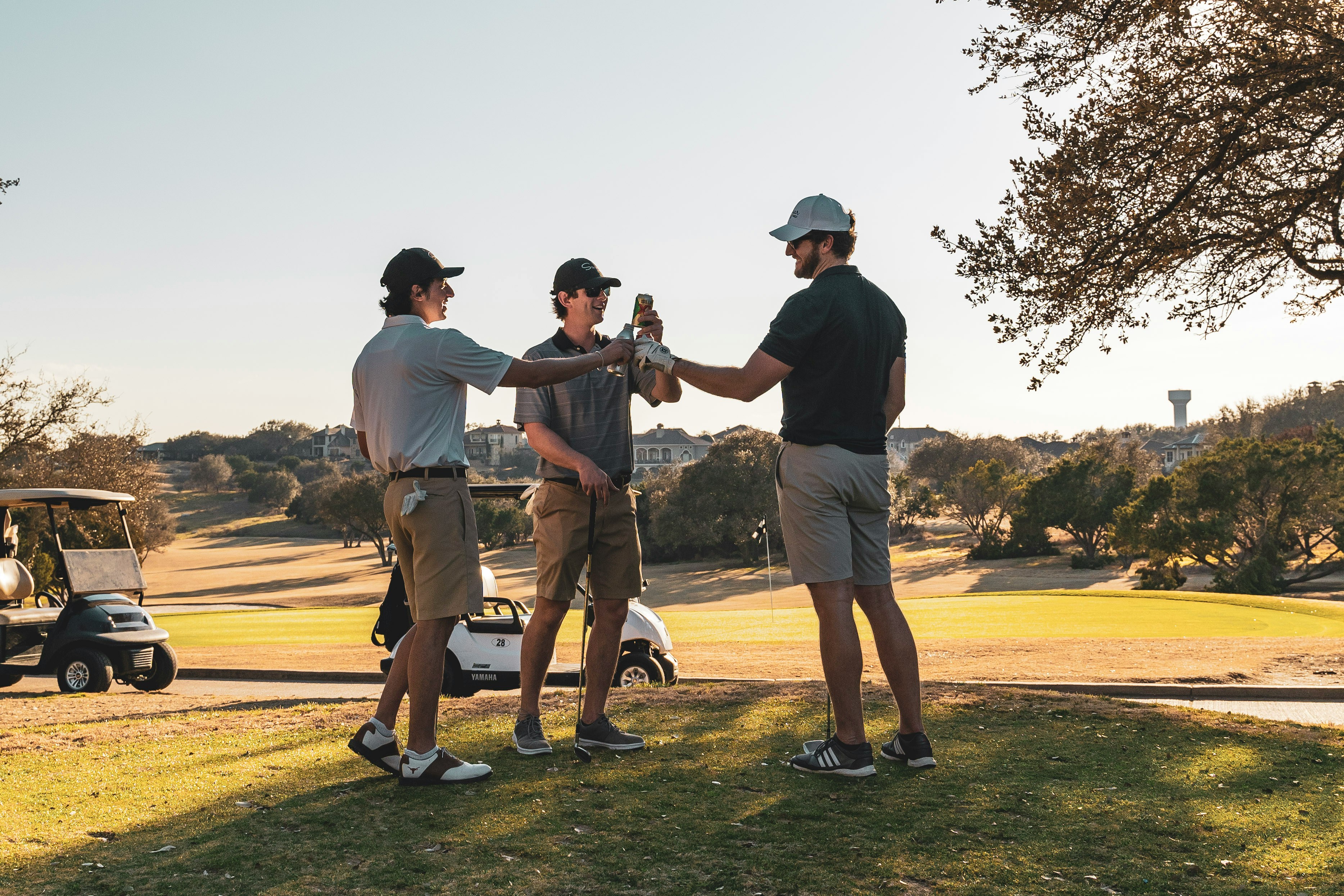
The only thing better than a good round of golf is taking a bit of coin off your buddies, regardless of how you played. That's why side games are key to a well-planned golf trip. They keep everyone in the mix, despite varying skill levels and physical states of mind. You can also spread the action across different days, courses and even seasons if you golf together a lot.
Here are five games worth knowing before your next trip. The first three are the classics every golfer should have in their back pocket. The last two are less common, but they travel well and teach fast.
Classic Side Games You Need To Know
Wolf
Wolf is probably the most popular foursome game in golf, and for good reason — it rewards good shots, creates shifting alliances, and gives every player a turn in the spotlight.
Format: Individual, with rotating temporary teams
Best for: Groups who like strategy and a little bit of chaos
Difficulty to learn: Easy
Here's how it works. Before the round, set a tee-off order and stick to it. On each hole, the last player to tee off is the "Wolf." After each of the other three players hits their tee shot, the Wolf has a choice: partner with that player (you must decide immediately after their shot, before the next player hits), or wait and see the next one. If the Wolf doesn't like any of the tee shots, they can go "Lone Wolf" and play the hole one-against-three.
Scoring is simple and can be adjusted to taste. A common setup:
Team Win: Wolf picks a partner, and their team beats the other two players. The Wolf and partner get 1 point each.
Team Loss: If the opposing team wins, they each get 1 point.
Lone Wolf Win: The Wolf wins 2 points.
Lone Wolf Loss: All players EXCEPT the Wolf each get 1 point.
The Wolf role rotates every hole, so everyone gets an equal number of turns. On holes 17 and 18, the player with the fewest points is usually given the Wolf role to give them a chance to catch up.
Why it works on a trip: Wolf keeps every tee shot meaningful. Even your worst ball-striker can become the hero of the hole if the Wolf picks them as a partner and they hit a good one.
Bingo, Bango, Bongo
If you've got a 5-handicap and a 25-handicap in the same foursome, this is the game. Bingo, Bango, Bongo completely removes total score from the equation and rewards three achievements on every hole:
Format: Individual
Best for: Groups with mixed skill levels
Difficulty to learn: Very easy
Bingo — First player in the group to get their ball on the green
Bango — Player closest to the pin once all balls are on the green
Bongo — First player to hole out
One point is awarded for each. That's three points up for grabs on every hole, 54 total over 18 holes.
The beauty of Bingo, Bango, Bongo is that it levels the field without needing handicaps. The weaker player is usually farther from the hole, which means they hit first, giving them the first crack at the Bingo point. Because Bango is measured only after everyone's on the green, a higher handicapper who chips on close has just as good a shot as a low handicapper who hits the green in regulation and leaves themselves a 30-footer.
One rule that matters: honour on the tee is determined by points earned, but order of play after the tee shot must be strictly furthest-from-the-hole first. No "ready golf" — it matters who gets to shoot when the Bingo point is on the line.
Why it works on a trip: Nobody is out of the action. A player who shoots 105 can still win the game, and everyone stays engaged through the final green.
Nassau
Nassau is the most widely played betting game in golf, with three separate matches in one round.
Format: Can be played individually or in teams of two
Best for: Groups who want a traditional match-play feel
Difficulty to learn: Easy
You're playing for:
Lowest score on the front nine
Lowest score on the back nine
Lowest score over all 18 holes
Each of the three is its own bet, and they're usually worth the same amount — a "$5 Nassau" means $5 on the front, $5 on the back, $5 on the total. Most commonly, it's played as a 2-vs-2 match, scored as match play (won holes, not total strokes), but it works just as well individually.
The twist that makes Nassau interesting is the press. If you're losing a match by two holes, you can "press" — start a new bet running concurrently for the remaining holes of that segment. This gives the trailing team a chance to recover without affecting the original wager. Some groups play automatic presses at two-down; others keep it optional.
Why it works on a trip: Nassau structures the round into three mini-competitions, so a bad front nine doesn't ruin the day. You're always playing for something.
Lesser-Known Games
4. Vegas
Vegas is a team game with a scoring twist that rewards consistency and punishes blow-up holes. Split the foursome into two teams of two. On each hole, each team's scores are combined into a two-digit number — lower score first.
Format: Teams of two
Best for: Groups who want team play with some math and some drama
Difficulty to learn: Medium (the scoring takes one hole to click)
For example: Team A's players make 4 and 5. Their team score on the hole is 45. Team B makes 5 and 6 — their team score is 56. The difference (56 − 45 = 11) is the number of points the winning team earns for the hole.
It sounds complicated, but it becomes obvious after one or two holes. The reason the game works is that a single bad shot hurts, a lot. If Team B's players had made 5 and 7, their score would be 57, and they'd lose the hole by 12 points instead of 11 — every stroke matters.
The 10-stroke rule: If a player makes 10 or more on a hole, the bigger number flips to the front. A 4 and a 10 becomes 104, not 410. This keeps a single disaster from mathematically wrecking the game beyond repair, but it still stings.
Why it works on a trip: Vegas keeps both players on each team locked in all day. You can't coast — your partner needs you to avoid the blow-up — and the running point totals make for great banter on the cart ride to the next tee.
5. Hammer
Hammer is match play with a "double or fold" mechanic borrowed from backgammon. Set a pot for each hole (any amount — $2, $5, or a beer, whatever the group agrees on). At any point during the hole, one player or team can "hammer" the other — meaning they're saying we're confident, let's double the bet.
Format: 1-vs-1 or 2-vs-2
Best for: Groups who like a bit of poker-style pressure
Difficulty to learn: Easy
The hammered side has two choices:
Fold — concede the hole immediately and pay the original bet
Accept — the pot for the hole doubles, and play continues
You can hammer at any time. After a great drive. After your opponent hits into the trees. On the green when you've got three feet and they've got thirty. And there's no limit — a hole can be hammered multiple times, doubling the pot each time.
The strategy is everything. Hammer too early and your opponent will always accept. Hammer too late and you miss the moment when they would have folded. Refuse to accept and you look like you have no faith in your own game.
Why it works on a trip: Hammer is a conversation game. Every hole becomes a negotiation, and the ribbing between hammers is half the fun. It also works well when skill levels are close — if the match is lopsided, play it 2-vs-2 and pair the handicaps to balance things out.
Picking the Right Game for Your Group
A few quick notes based on who you're playing with:
Mixed handicaps (10+ strokes between best and worst player): Bingo, Bango, Bongo or a Scramble will keep it fair. Wolf can also work because the Wolf-picks-partner mechanic lets the stronger players carry when needed.
Similar skill levels: Nassau, Vegas, or Hammer reward consistency and create closer matches.
First round of the trip: Start with something simple — Bingo, Bango, Bongo or a straight Nassau. Save Vegas and Hammer for day two or three when everyone's loosened up.
Last round of the trip: Wolf. It's the most fun, the rotation gives everyone a turn as the main character, and it's the game people tell stories about on the flight home.
One last thing worth saying out loud: the stakes don't need to be money. A sleeve of balls, the next round of drinks, or the right to pick the music in the cart all work just as well — and usually make for better stories.
Golf trips for groups who want more than a tee time.
We design complete golf experiences for groups of 8–16. We curate the golf, the lodging, the transport, and the details you didn't know you needed — so your crew just shows up and enjoys the journey.